
A spa business plan has the same core sections as any small business plan, but the numbers behave differently. A day spa sells time in treatment rooms, delivered by licensed therapists, so labor is the biggest cost and empty rooms are the biggest risk. Retail, packages and gift cards make up a large share of profit, and many first-time owners leave them out of the plan entirely.
This guide walks through each section in the order a lender or investor expects to read it, with what to include, the figures to research, and the questions your plan needs to answer. If you are opening a medical spa that offers injectables or laser treatments, see our med spa business plan guide instead, since medical oversight changes the ownership and staffing sections.
1. Executive summary
Write this section last and keep it to one page. Many readers stop here, so it should stand on its own and cover five things:
- The spa's name, location and concept, whether a day spa, a wellness spa, a massage-focused studio, or a facial and skin bar.
- The owner and key team members, with a line on each person's experience in spa operations or management.
- Your core client in a sentence, for example professionals aged 30 to 60 within a 15-minute drive who book a massage or facial at least once a quarter.
- The total startup budget, how much you are contributing, and how much you are asking for.
- Projected first-year revenue, the month you expect to break even, and your year-three revenue target.
If any of the five is still a guess, the sections below will show you where the gaps are.
2. Company description, concept and licensing
This section explains what kind of spa you are opening and shows that you understand the licenses it needs. Lenders read it to judge whether the concept is clear and whether anything could stop you opening on time.
Start with the concept. A day spa built around massage and facials has a different layout, staff mix and price point from a wellness spa with hydrotherapy and saunas, or a compact facial bar in a retail center. Describe the experience in two or three sentences, then list what sets it apart, such as longer treatment times, a specialty like lymphatic massage, couples suites, or a membership model.
Then cover the legal and licensing setup:
- The legal entity (usually an LLC) and who owns it.
- Practitioner licenses for every service on your menu. Most states regulate massage therapy, so each therapist needs a state license, and estheticians and nail technicians are licensed separately through the state cosmetology board.
- Establishment licenses for the location itself. Many states license the business as well as the people working in it. In Florida, for example, a spa offering massage needs a massage establishment license, and in Texas, estheticians can only work in a facility holding a state establishment license. A spa offering both massage and skin services may need both types.
- Local requirements such as a business license, zoning approval, health department permits and a seller's permit for retail sales.
Finish with the location: the address or target area, square footage, number of treatment rooms, and lease terms.
3. Market analysis
The market section shows there are enough clients nearby to fill your rooms, and that you know who you are competing with. Open with the national picture, then spend most of the section on your local area.
Nationally, the International Spa Association (ISPA) found that U.S. spa revenue hit a record $23.5 billion in 2025, from 191 million visits across 22,060 locations. Day spas make up the large majority of those locations, and the average day spa visit brought in $110, compared with $181 at resort and hotel spas. Use these as context. A new spa will not match an established one in its first year.
Then define your trade area as the drive time most clients will accept for a regular appointment, usually 10 to 20 minutes, and document:
- Population and median household income within that radius (U.S. Census data is free).
- The share of residents aged 30 to 64, the core market for regular massage and facial clients.
- Nearby demand drivers such as offices, hotels, gyms, upscale retail and wedding venues.
Next, list every day spa, massage studio, facial bar, med spa and full-service salon offering spa treatments in that radius. For each, note the main services, the price of a 60-minute massage and a signature facial, membership or package offers, Google rating and review count, and how far ahead their online booking is full. Close with a short paragraph on the gap you will fill, whether that is price, specialty, convenience, atmosphere or hours.
4. Services, treatment menu and pricing
List the services you will offer at opening and what you will add later. A focused menu is easier to staff, train and market than a long one, and most new spas do better launching with fewer, well-defined treatments.
For each service category, show how it is priced, what it costs you to deliver, and who can perform it:
| Service | Priced by | Main direct costs | Who performs it |
|---|---|---|---|
| Massage (Swedish, deep tissue, specialty) | Per session, by length | Therapist pay, linens, oils | Licensed massage therapist |
| Facials and peels | Per treatment | Backbar product, esthetician pay | Licensed esthetician |
| Body treatments (wraps, scrubs) | Per treatment | Product, linens, therapist pay | Massage therapist or esthetician, per state rules |
| Waxing and brow services | Per area | Wax and supplies, staff time | Esthetician or cosmetologist |
| Nail services | Per service | Polish and supplies, technician pay | Licensed nail technician |
| Packages and spa days | Bundled price | Combined service costs | Mixed team |
| Memberships | Monthly fee | Included services | Mixed team |
| Retail skincare and body care | Per product | Wholesale cost | Front desk and providers |
Two things matter most to readers here. The first is how much revenue each treatment room produces per hour, since rooms and therapist time are your capacity limits. A 50-minute massage priced competitively but booked with a 10-minute turnover earns more per room-hour than a 90-minute treatment that needs 20 minutes to reset. The second is recurring and higher-margin revenue: memberships, prepaid packages, gift cards and retail all improve cash flow, and each should have its own line in the plan.
Set prices from your competitor research in section 3. Position yourself deliberately against local competitors rather than discounting to win clients, since discounted first visits tend to attract people who do not come back at full price.
5. Staffing and operations
Labor is the largest cost in most spas, and hiring is the hardest part of running one. In ISPA's latest study, 61% of U.S. spas reported open positions they were trying to fill, with about 21,450 service provider roles unfilled. Your plan needs to show how you will find, pay and keep therapists, not just how many you need.
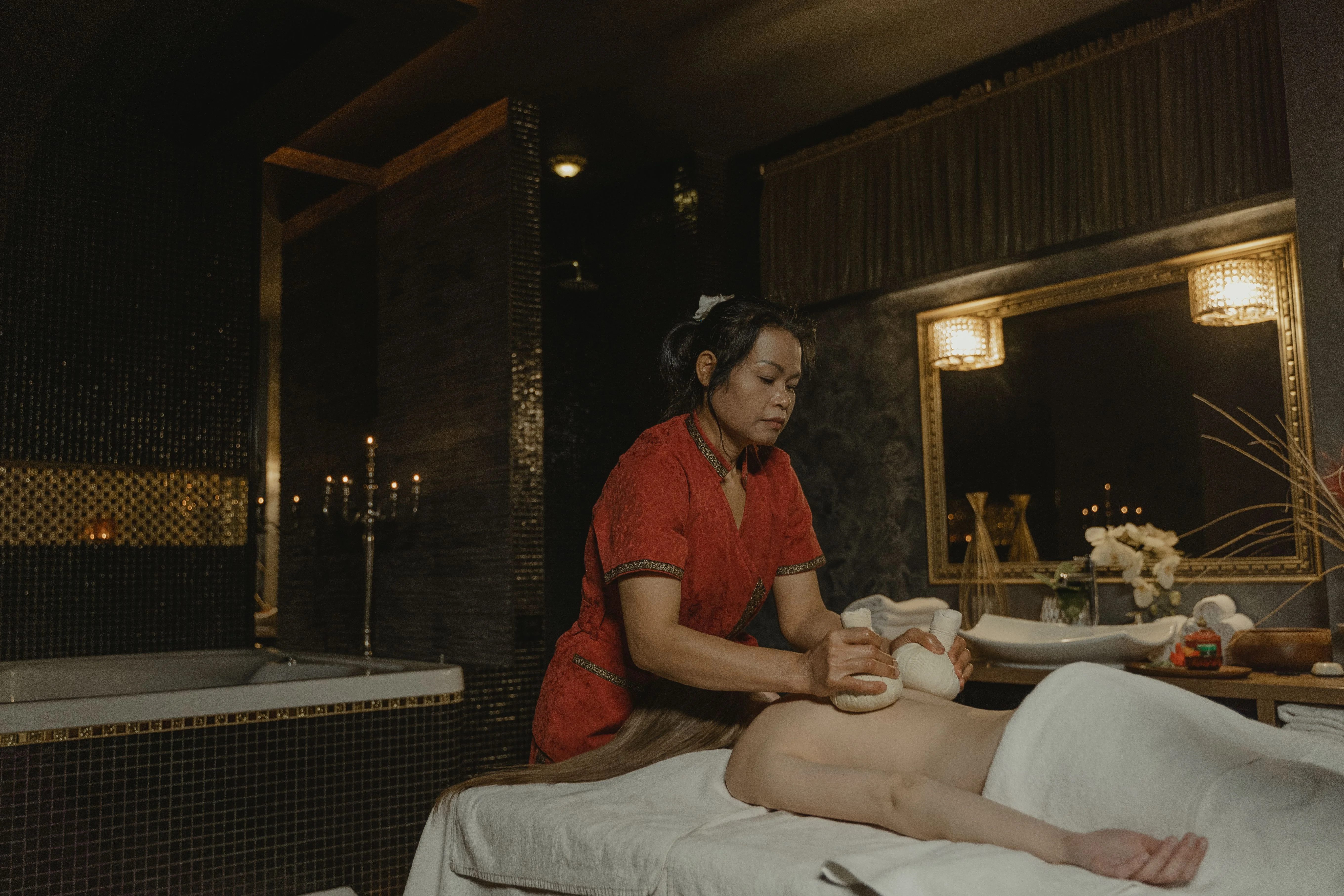
A typical opening team for a four- to six-room day spa might include:
- A spa manager or owner-operator
- Three to five licensed massage therapists, a mix of full-time and part-time
- One or two licensed estheticians
- Front desk coordinators to cover all opening hours, who also handle retail, rebooking and gift card sales
For each role, give the start date and pay model (hourly, commission, or a base plus commission), and explain how you will recruit, whether through local massage and esthetics schools, referral bonuses, or offering more predictable schedules than competitors. Show the booking level that justifies the next hire, for example adding a therapist once existing staff are consistently booked above 75% to 80% of their available hours.
Next, describe how a client moves through the spa:
- Online booking or phone inquiry, with a card on file to hold the appointment
- Intake form with health questions and preferences, completed before arrival
- Arrival, changing and relaxation area
- Treatment
- Retail recommendations and checkout
- Rebooking for the next visit before the client leaves
Also list the systems that support it: booking software, payment processing, gift card and membership management, inventory tracking, and laundry, whether handled in-house or by a linen service.
6. Marketing and client retention
The marketing section answers one question: how will you fill your rooms in the first year, and keep them full after that? Break it into three phases.
Before you open
- Claim and complete your Google Business Profile, and get your website live with online booking.
- Build a waitlist with a founding-member offer, such as a discounted first year of membership for the first 100 sign-ups.
- Hold a preview event for local businesses, hotel concierges and wellness professionals who can send you clients.
The first six months
- Local search and Google reviews. Ask every satisfied client for a review at checkout or in a follow-up message, and set a target such as 100 reviews in six months.
- Paid social and search ads with a monthly budget and a target cost per new client.
- Partnerships with gyms, yoga studios, bridal shops, hotels and corporate HR teams.
Keeping clients coming back
Repeat visits are what make a spa profitable, so show how you will turn first-time guests into regulars: rebooking before clients leave, a membership program with a monthly included service, prepaid packages, birthday and anniversary offers, and email and SMS reminders.
Plan for gift cards as a marketing channel, not just a product. Gift card sales peak around the holidays, Valentine's Day and Mother's Day, and each card brings in a new client who may not have found you otherwise. Build a promotions calendar around those dates.
Close the section with a simple table of channels, monthly spend and expected new clients per month, so lenders can see how marketing spend links to bookings.
7. Startup costs and funding
One cost model puts a small day spa with four treatment rooms at roughly $203,000 to $328,000 to open, plus $34,000 to $44,000 a month to run. A larger spa with custom interiors, wet areas or hydrotherapy can run well past $500,000. For comparison, the Spavia day spa franchise lists a total initial investment of $479,000 to $885,000, which includes the franchise fee, build-out, equipment and three months of operating funds.

Break your budget into line items like the ones below, then replace each range with real quotes from contractors, landlords and suppliers:
| Cost category | Typical range |
|---|---|
| Leasehold improvements | $30,000 to $105,000 |
| Spa equipment and furniture | $40,000 to $150,000 |
| Opening inventory (backbar and retail) | $10,000 to $45,000 |
| Initial marketing | $10,000 to $37,500 |
| Technology and software | $10,000 to $22,500 |
| Insurance | $5,000 to $18,000 |
| Legal and accounting | $5,000 to $15,000 |
| Signage and branding | $5,000 to $15,000 |
| Permits and licensing | $5,000 to $12,000 |
On top of these one-time costs, hold a working capital reserve of three to six months of operating expenses. At $34,000 to $44,000 a month, that works out to roughly $100,000 to $265,000. Spas take time to build a regular client base, and this reserve is what carries you through the slow early months.
Finally, state how much you are contributing and where the rest comes from. Common sources are SBA 7(a) loans, equipment financing or leasing for treatment tables and machines, landlord tenant-improvement allowances, and partner or investor equity.
8. Financial projections
Build your projections from capacity: how many treatment rooms you have, how many hours they are open, and how full you can realistically keep them. Lenders discount forecasts that start from a revenue goal and work backward.
Start with service revenue per room:
Monthly service revenue = rooms × open hours × utilization rate × revenue per room-hour
Remember that utilization is limited by therapists as well as rooms. A room is only bookable when a licensed provider is available to work in it, so check your staffing plan against your room hours. A new spa might start near 25% to 35% utilization and build toward 60% to 70% over the first year. Add retail, membership, package and gift card revenue as separate lines.
For a benchmark, ISPA's latest figures put the average U.S. spa at about 8,640 visits a year, or roughly 166 a week, with about $1.06 million in revenue. Treat that as a mature-business reference, not a year-one target.
You will need three statements: a monthly profit and loss for year one, then annual figures for years two and three; a cash flow forecast, which matters more than the P&L in the early months; and a break-even analysis. To find break-even, divide fixed monthly costs (rent, salaried staff, software, insurance, loan payments) by your contribution margin, which is revenue minus therapist commissions, product costs and card fees, as a percentage.
Then show the downside. Add a conservative scenario with slower client growth, for example 25% below your base case, and show that your working capital reserve still covers the gap. Margins in this business are tight. In ISPA's latest study, fewer non-resort spas reported profit margins above 10% than the year before, so a plan that assumes high margins from year one will not hold up to scrutiny.
Common mistakes to avoid
- Planning rooms without planning therapists. Six treatment rooms with three therapists is a three-room spa, so build your capacity numbers from staffing, not square footage.
- Leaving out retail, gift cards and memberships. These are some of the highest-margin revenue lines in a spa, and leaving them out understates what the business can earn.
- Cutting the working capital reserve to pay for nicer finishes. A beautiful spa with no cash runway is at more risk than a simpler one that can survive a slow first six months.
- Opening with a long menu. Every extra treatment needs training, products and storage. Start focused and add services once you know what your clients book.
- Discounting to fill the book. Deep first-visit discounts attract bargain hunters who rarely return at full price.
- Treating the plan as a one-time document. Update it every quarter against actual numbers, since it becomes your operating budget once you open.
Frequently asked questions
How much does it cost to open a day spa?
A small four-room day spa typically costs around $200,000 to $330,000 to open before working capital, and larger or more luxurious spas can pass $500,000. Add three to six months of operating expenses as a reserve on top of that.
Are day spas profitable?
They can be, but margins are tighter than many owners expect, because labor is the largest cost and rooms only earn money when they are booked. The spas that do best keep therapists busy, rebook clients before they leave, and earn a meaningful share of revenue from retail, memberships and gift cards.
How many treatment rooms should a new spa have?
Match room count to the number of therapists you can realistically hire and keep busy. Many independent day spas open with four to six rooms, which is enough to run couples treatments and overlapping appointments without carrying too much unused space.
Do I need a license to open a spa?
Yes. Each practitioner needs a state license for the services they perform, and many states also license the business location, such as a massage establishment or cosmetology establishment license. You will also need local business, zoning and health permits.
How is a spa business plan different from a med spa business plan?
A med spa offers medical treatments such as injectables and lasers, so its plan has to address physician oversight, ownership rules and expensive devices. A day spa plan focuses more on therapist staffing, room utilization and retail. Our med spa business plan guide covers the medical side in detail.