

A med spa can generate plenty of inquiries and still have an acquisition problem. Some people never book, some do not attend, and others arrive expecting a treatment that is unsuitable for them or a price the clinic never offered. Buying more of those inquiries makes the report look busier without making the business healthier.
A useful med spa marketing plan connects four decisions: which services the clinic can responsibly grow, how suitable prospective patients discover them, how an inquiry becomes an attended consultation, and whether the resulting business covers its acquisition cost. Start with that chain before choosing another advertising channel.
Choose a service and a capacity limit before choosing a campaign
Begin with one service line that has available clinical capacity and a clear consultation process. Document who handles the assessment, what information the front desk can provide, the consultation fee if there is one, and the number of new appointments the team can accommodate without delaying existing patients.
Then work backward from the appointment book. If there are eight suitable new-consultation slots each week, a campaign designed to produce forty bookings is a mismatch even if the ads perform well. Either create capacity first or cap the campaign. Do not let a discount determine a clinical recommendation.
The offer should explain the next step accurately. A paid assessment with a clearly stated fee can be a stronger proposition than an ambiguous promise of a free treatment. If a consultation charge is credited toward a later purchase, explain the conditions before someone books. Make sure staff can describe the same arrangement without improvising.
Make local discovery useful to someone comparing clinics
For an owner starting from an uneven online presence, the first audit is straightforward: can a person confirm the location, hours, providers, services and booking route without hunting across several sites?
Google's local-ranking guidance emphasizes relevance, distance and how well-known a business is. Complete, accurate Business Profile information helps Google understand a business, but a clinic cannot pay Google for a better organic local ranking. Distance also means that a strong position in one neighborhood does not guarantee the same visibility across an entire metro area.
Check the profile against the website and appointment system. Update special hours, fix a broken booking link, choose an accurate business category and replace dated photographs. Add practical arrival information, such as parking and the correct entrance, where appropriate. These details help people decide whether visiting is workable; they are more useful than repeatedly adding a city name to vague promotional copy.
Build service pages that answer the questions behind the inquiry
A service page should help someone understand the consultation, not make a diagnosis or promise an outcome. Have an appropriately qualified clinician review clinical statements, treatment limitations and safety information before publication. Name the actual provider and credentials accurately rather than relying on an unsupported claim that the team is the best.
For each priority service, give the reader:
A plain-language description of the service and the assessment required before treatment.
Who provides it, where appointments take place and how to request a consultation.
What the quoted price includes, or the factors that prevent a meaningful price from being given before assessment.
Clinician-reviewed information about suitability, limitations, risks and recovery, without guarantees.
Answers to genuine administrative questions, including consultation fees and rescheduling arrangements.
Use questions the front desk actually receives. For example, “Is the consultation fee separate?” deserves a direct answer if it is a recurring source of confusion. It does not need a thousand-word article built around it. Conversely, a complicated treatment comparison should not be reduced to a sales slogan merely to keep the page short.
These pages also support AI-search visibility. Google's guidance for generative AI search says foundational SEO remains relevant and emphasizes distinctive, useful content. Publish information that is specific to the clinic and accessible as readable text, with clear headings and relevant internal links. This creates a better source for readers and search systems, but it does not guarantee an AI citation or recommendation.
Fix the handoff from inquiry to consultation
Assign an owner to each incoming channel: phone, booking form and social inbox. A prospect should not receive three unrelated replies because every team member assumes someone else is managing the conversation. Establish response coverage during staffed hours and an accurate after-hours message that explains when a person will reply.
Keep initial intake proportionate. Staff can confirm the requested service, preferred appointment time and administrative details, then direct clinical questions into the clinic's appropriate assessment process. Avoid inviting people to send detailed medical histories or photographs through an ordinary social-media inbox.
Record where the handoff fails. “Not booked” is too broad to guide a decision. Useful reasons include no response after follow-up, unavailable appointment times, fee mismatch, service not offered and clinical assessment required. A large number of scheduling mismatches points to an operational problem; a large number of requests for an unavailable treatment points to the message or targeting.
Track attended consultations separately from bookings. Review cancellations and no-shows alongside the clarity of reminders, directions and policies. Follow-up should make the agreed next step easy, while respecting the person's preferences and the communication permissions that apply.
Calculate acquisition cost at the patient level
Cost per lead is an early diagnostic, not the final measure of a campaign. Divide acquisition spending by new paying patients to understand patient acquisition cost, using a consistent definition of spending and a defined observation period. Keep existing patients returning through an ad separate from genuinely new patients.
Hypothetical example: A clinic spends $1,500 on advertising and $500 on campaign production and management during one month. That $2,000 produces 100 inquiries, 40 booked consultations, 30 attended consultations and 15 new paying patients.
Acquisition spending per inquiry is $20.
Acquisition spending per attended consultation is approximately $66.67.
Acquisition spending per new paying patient is approximately $133.33.
Suppose each new patient's first purchase brings in $400 after discounts and refunds, with $230 in directly attributable delivery costs. That leaves $170 of first-purchase contribution before acquisition spending and fixed overhead. Across 15 patients, the contribution is $2,550. After the $2,000 acquisition spend, only $550 remains toward rent, fixed salaries and other overhead. The campaign's $6,000 of revenue therefore does not mean it generated $6,000 of profit.
This simplified illustration is not an industry benchmark. Include relevant consultation delivery costs in a real analysis, including appointments that do not lead to treatment. Count each cost once, and use the same treatment of labor and fees across campaigns. Returns from later visits can improve the economics, but do not assume them before they occur. Review 30-, 60- and 90-day patient cohorts so an attractive lifetime-value estimate does not conceal a cash shortfall today.
Use reviews and patient stories without creating avoidable risk
Make an honest review request part of a consistent process rather than reserving it for people who have already praised the clinic. The FTC's review-rule guidance explains that incentives conditioned on positive reviews are prohibited, and that asking only apparently happy customers can raise concerns under the FTC Act. Review platforms can impose additional restrictions, so a no-incentive request is a sensible operating default.
Patient stories and before-and-after images need their own approval process. For covered entities, HHS explains that marketing uses or disclosures of protected health information generally require written authorization, with limited exceptions. Have qualified counsel confirm which privacy, consent and professional advertising requirements apply to the clinic and the proposed use. A general treatment-consent form should not be assumed to authorize an advertising campaign.
Keep the operational safeguard simple: do not publish a patient asset until the required permissions and clinical review are documented. Avoid editing or selecting images in a way that misrepresents results, and do not confirm someone's patient status while replying publicly to a review.
A manageable first 30 days
Week one: Choose one service line, confirm consultation capacity and reconcile the last month's inquiries with bookings, attendance and new-patient purchases. Write down the missing data rather than filling gaps with assumptions.
Week two: Repair the Business Profile, booking route and priority service page. Test the journey on a phone, including the confirmation message and arrival instructions. Have clinical and compliance reviewers approve the content that needs their expertise.
Week three: Run one limited acquisition test with a spending cap the business can afford. Keep the service, geography and main offer sufficiently consistent to learn something. Review advertising-platform eligibility before launch, and do not add patient lists or health information to ad tools without a proper privacy review.
Week four: Compare the test's inquiries, attendance and new-patient contribution with the starting position. Improve the largest observable bottleneck before expanding. A small sample is a reason for caution, not a basis for declaring a permanent winning channel.
Retention belongs in the same plan, but it needs its own economics and communication strategy. Our guides to med spa email marketing and spa membership pricing cover those next steps. The immediate goal is a repeatable acquisition process that the clinic can deliver responsibly and afford to keep running.
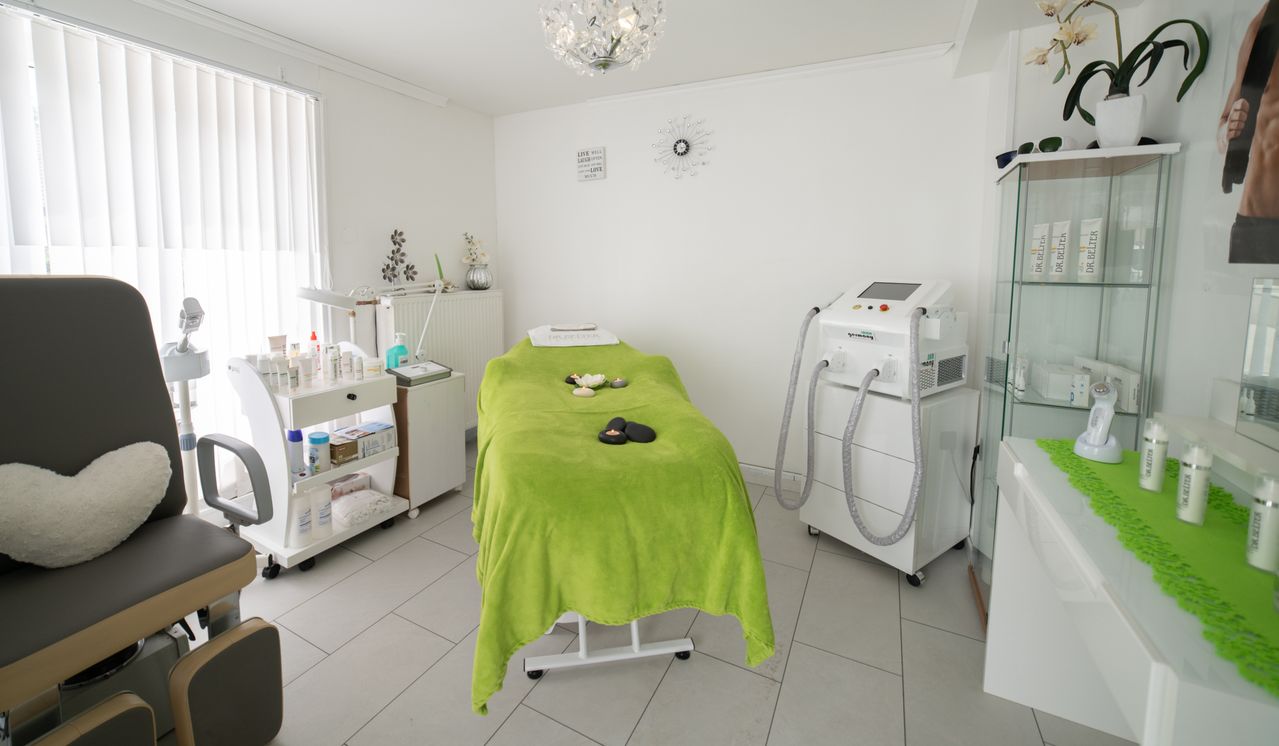
Illustrative spa interior photograph by Nico Becker via Pexels, used under the Pexels license. The pictured facility is not a case study or an endorsement.