

A full appointment book does not tell a med spa owner how much money the business is making. A clinic can increase sales while discounts, product costs and extra staffing absorb almost every additional dollar. The useful question is how much of each dollar remains after the work required to earn it.
Med spa profit margin is profit divided by revenue, expressed as a percentage. The calculation is simple; deciding which profit figure belongs in it is where comparisons often go wrong. Before adopting a benchmark, separate service-level contribution, operating profit and the cash available to the owner.
What counts as a good med spa profit margin?
There is no useful universal target without a definition of costs. A practice paying its owner a market-rate salary cannot be compared directly with one where the owner treats patients full time without a salary expense. A new location carrying unused rooms also has different economics from an established clinic with the same revenue.
In a February 2, 2024 article published by AmSpa, brokerage Pacific Reliance suggested a net-profit target of at least 20%, with highly efficient practices at 30% to 35%. Those figures are the author's advisory targets, not a measured national average or a promise of what an individual clinic should earn. Use them as a prompt to examine the books, not as a substitute for understanding them.
For a meaningful comparison, write down whether the figure includes owner compensation, all provider labor, equipment costs, interest and taxes. Ask the same questions of a seller's presentation or a software dashboard. A percentage without those answers can create more confusion than insight.
Separate three different views of profitability
Gross margin measures revenue less the costs classified as cost of sales. Clinics may classify provider labor differently, so confirm what is included before comparing gross margins. Moving a salary between categories changes this subtotal without making the business more profitable.
Contribution margin subtracts the costs that change with the sale or appointment. For an operational analysis, that might include treatment supplies, transaction fees and genuinely variable provider compensation. Fixed salaries belong elsewhere in that model. A contribution calculation shows what remains to cover fixed expenses and profit.
Operating margin reflects operating profit after operating expenses. Interest and income taxes are normally outside that subtotal. Net profit goes further down the income statement. EBITDA excludes interest, taxes, depreciation and amortization, so it should not be labeled net profit or treated as cash available to withdraw.
Agree on consistent classifications with the clinic's accountant. The goal is a report that answers the same question every month, with every expense counted once.
A worked monthly example
Hypothetical illustration: A clinic records $100,000 in monthly revenue after discounts and refunds. Its costs are classified as follows. These figures are invented to explain the calculation, not presented as industry benchmarks.
Treatment products and consumables: $25,000.
Variable provider compensation: $20,000.
Payment processing and other variable selling costs: $3,000.
Fixed operating expenses: $40,000, including fixed payroll, an allowance for the owner's working role, rent, insurance, software, marketing and equipment depreciation.
The first three categories total $48,000. Contribution is therefore $52,000, or 52% of revenue. Subtracting the $40,000 of fixed operating expenses leaves $12,000 of operating profit, an operating margin of 12%. Interest and income taxes have not been deducted, so this is not a 12% net margin.
Under the same simplified cost structure, $110,000 in revenue produces $57,200 of contribution and $17,200 of operating profit. That improvement depends on fixed expenses remaining unchanged and the service mix preserving the 52% contribution rate. If extra revenue requires another salaried provider, longer opening hours or a different product mix, rebuild the calculation rather than projecting the old percentage.
Calculate break-even before setting a sales target
The Small Business Administration's break-even guidance calculates sales-dollar break-even by dividing fixed costs by the contribution-margin ratio. It also cautions that break-even is an estimate and explains the need to separate fixed and variable components of mixed costs.
For the hypothetical clinic above, $40,000 divided by 0.52 gives approximately $76,923 in monthly revenue to break even at the operating-profit level used in this model. To produce $15,000 of operating profit, the same assumptions require approximately $105,769: the $40,000 cost base plus the $15,000 target, divided by 0.52. Financing and tax obligations need their own provision.
Translate the revenue target into realistic appointment capacity. If the necessary completed visits exceed the slots the team can safely deliver, the plan requires a change in pricing, cost structure, capacity or service mix. A larger sales target alone does not solve that mismatch.
Test discounts against contribution, not revenue
A discount can look small at the checkout and large on the income statement. Consider another hypothetical service sold for $500 with $250 of variable delivery costs. It contributes $250 before fixed overhead. A 10% discount reduces the price to $450 and contribution to $200, assuming variable costs remain $250.
That is a 20% reduction in contribution per appointment. The clinic would need 25% more appointments to generate the same total contribution, before considering additional capacity costs. If the promotion mostly attracts existing patients who would otherwise have paid the usual price, extra volume may never arrive.
Before launching an offer, record the normal price, proposed price, variable costs, available slots and expected number of genuinely additional visits. Apply the same discipline to bundles and spa membership pricing. Clinical suitability and safe appointment lengths remain constraints, regardless of the financial model.
Find the specific reason margin changed
Review revenue and costs by service category, then investigate changes rather than assuming the team needs to sell harder. A higher product-cost percentage might reflect a different treatment mix, supplier pricing, wastage or a recording error. Reconcile usage and invoices before attributing the change to any one cause.
Look at provider and room utilization alongside contribution per occupied hour. Include preparation, documentation and turnover time when judging how much capacity a service consumes. An apparently attractive appointment can be less useful to the business if its full delivery time is missing from the calculation.
Keep acquisition economics visible, too. A campaign that fills the calendar can still be expensive after creative work, management fees and consultations that do not convert. Our med spa marketing guide shows how to connect inquiries with attended consultations and new-patient contribution.
Close the gap between profit and cash
The SEC's guide to financial statements distinguishes the income statement's profit measure from the cash-flow statement's account of cash generated and used. Before taking money out of the business, reconcile the profit report with a cash forecast. Equipment purchases, loan principal payments, inventory purchases and owner distributions can affect cash differently from operating profit. Prepaid packages also create future delivery commitments; their initial cash receipt should not be mistaken for money free of obligations.
At the monthly review, put five figures on the same page: revenue after discounts and refunds, contribution, fixed operating expenses, operating profit and cash available after upcoming commitments. Add the prior month and a rolling three-month view. Choose one observed problem, assign responsibility and check whether the next month's result improves.
A sound margin target is one the clinic can explain, measure consistently and support with responsible delivery. The best starting point is a reconciled set of books and a realistic appointment model, not someone else's headline percentage.
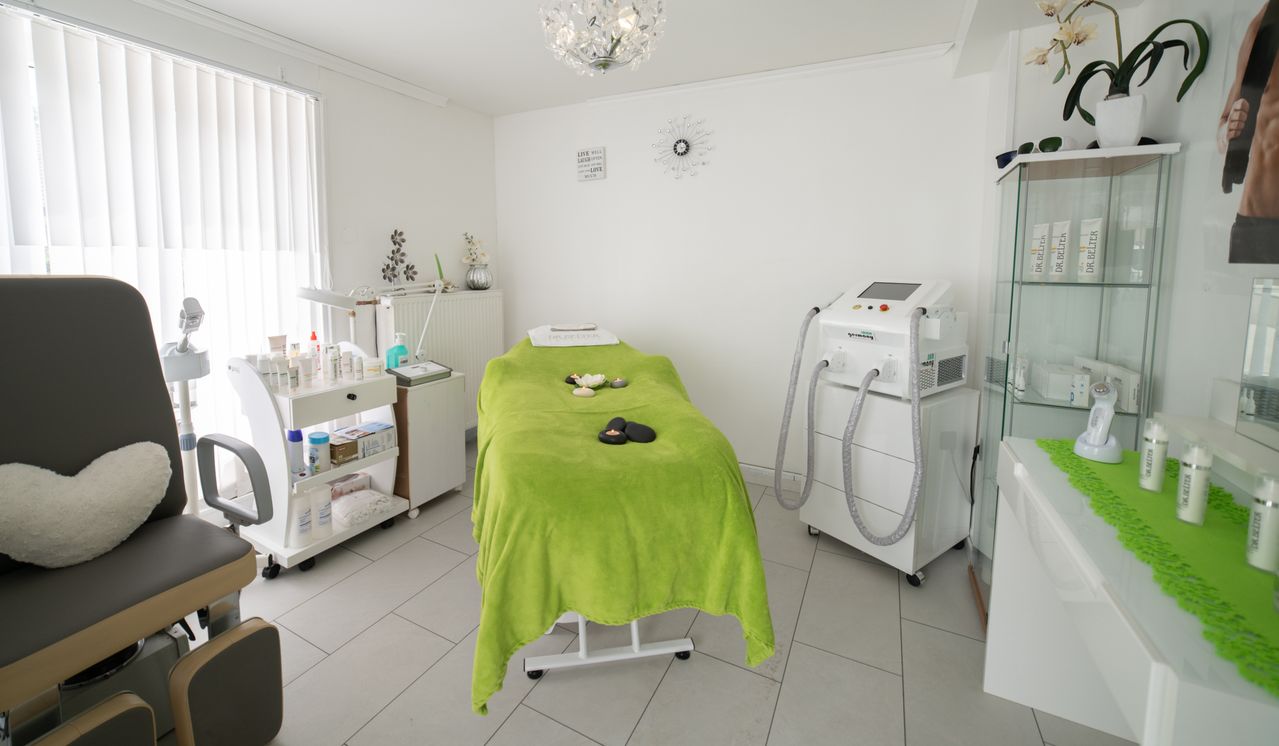
Illustrative clinic photograph by Nico Becker via Pexels, used under the Pexels license. The pictured facility is not the hypothetical business described in this article.